
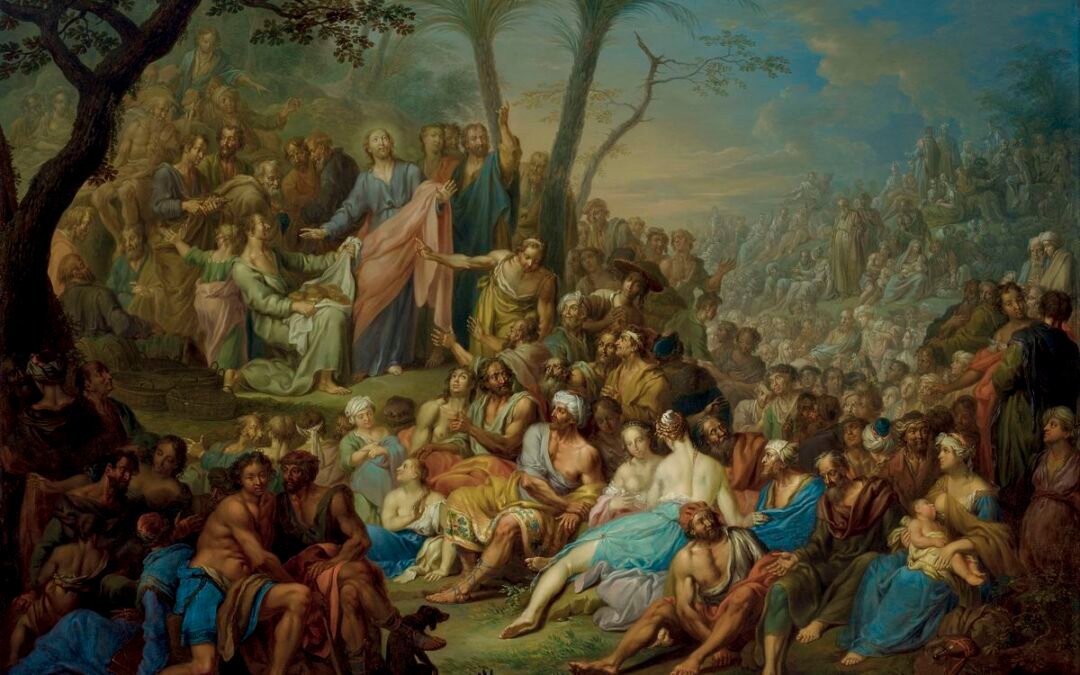
For the Gospel on this sixth Sunday after Pentecost, Our Lord feeds the hungry multitude who have come to Him to hear the Gospel. Hundreds—even thousands—of people gathered to hearken unto Jesus speak of the Kingdom of Heaven: men, women and their children, and perhaps even those whose curiosities could not keep them from beholding the Christ from afar. Some could even have been doubters who merely take this as an opportunity to filter out supposed contradictions to an otherwise consistent message of salvation and truth. Yet, whatever their states of life may be, they were all there—a massive crowd, with various experiences, problems, concerns, situations.
The God-Man, in His human and Divine nature, understood full well that despite He, as the Bread from Heaven, the Nourisher of souls, should also give way to the inclinations and needs of mortal men; thus, He asks whether the crowd may be able to eat, thence satiating their need for sustenance that have been wanting for three days. The marketplace is far off: each of these should trudge by foot all the way into the cities just so they could have their fill of food and drink. It poses such an inconvenience indeed, especially with little ones in tow; then, as they return for the culmination of Our Lord’s preaching, it would belabour them anew. At this, Jesus had willed in Himself to make the people rest: food shall be provided, God shall work a miracle today.
In retrospect (and if we should place ourselves in the shoes of the gathered assembly), it might have seemed normal to us to have food served freely, as is conceivably due. We could have plainly taken our food, given thanks for the hearty meal, and gone along our way without thinking twice as to where it came from. Moreover, we would have never suspected that a miracle had taken place, as the process through which it was undertaken was not divulged nor gossiped about. Our sustenance was as quiet and simple as something borne out of the ordinary; yet, unbeknownst to our most finite minds, the Lord has already nurtured both our bodies and our souls.
Isn’t it the Eucharist similar to this? Whenever we assist at Mass, all we behold in our presence is bread and wine in its physical accidents: nothing extraordinary seems to be taking place yet through Transubstantiation, matter becomes Our Lord’s true Body and Blood. As we then partake of this, we do not only receive the tangible but God Himself who loves us and wills us to be saved. Quietly, among the most inaudible parts of the Mass, Our Lord manifests Himself and dispenses His gentle care unto us—that through receiving Him, grace lifts our souls and makes us united unto Him.
Verily enough: as Christ Himself had said, “Man does not live by bread alone”, we are called to remember that our tangible nature is not the pinnacle of our existence. We were created to be sustained, not merely by mammon, but also God Himself. He is the water of life and He is the bread of heaven; and we, who sigh—poor children of Eve—hope and exist through His ineffable Love in the Eucharist.
In the Mass, the testimony of God’s Love, we find our solace and rest.